Conversation with Keshema Davidson
GPDGW: A Monthly Bloom Interview Series
Authentic conversations with leaders from the Bloom Neighborhood showcasing snapshots of challenges and practitioner-focused insights
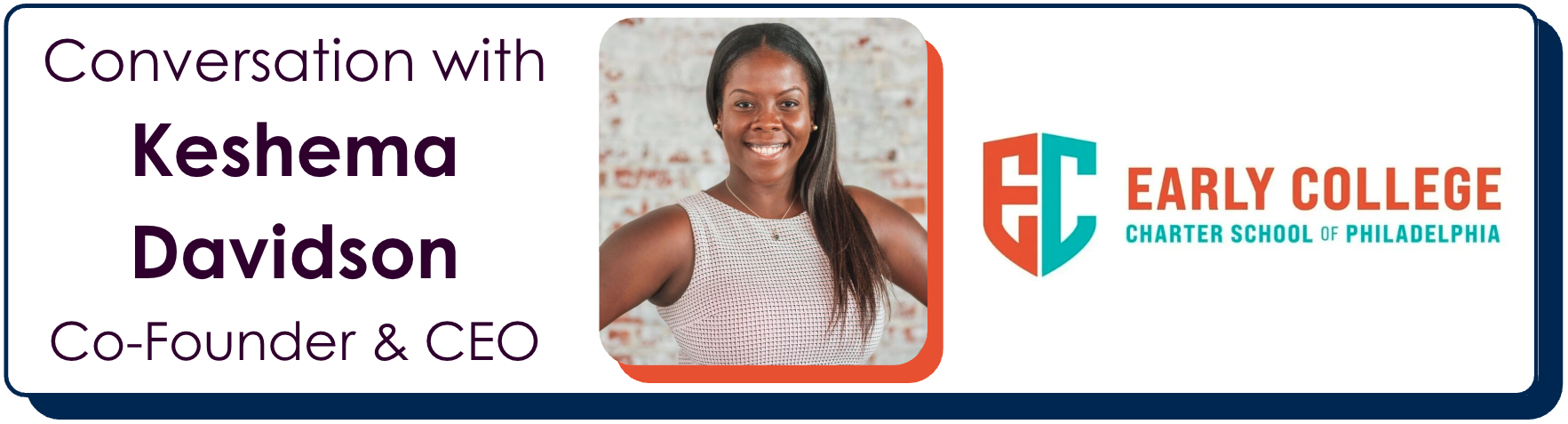
Keshema Davidson co-led the foundation responsible for designing and completing the charter school application for Early College College School of Philadelphia (ECPHL), Pennsylvania’s first public, open-enrollment early college secondary school, and the first new charter school approved in eight years. ECPHL opened its doors to students on August 24, 2026.
What’s top of mind for you lately?
I've been reflecting a lot on diverse learners, the young people coming to us who have been, in some cases, underserved by educational systems. I ask myself, ‘what am I promising that child? What does early college look like for them? What does it look like for us to challenge all students academically while holding us collectively to high expectations?’
The reality is that we fundamentally believe that all kids can learn, and all kids can experience tremendous growth. And, there are some very real challenges that a lot of children are facing. In the face of that, we remain committed to doing our absolute very best.
How do you approach supporting diverse learners?
I believe that if we create a safe space, both physically and emotionally, led by trusted adults and reinforced with high expectations and clear systems, that allows young people to express themselves in a productive way. We also have to acknowledge when expectations aren't met. If we do that well, it will be something that helps move the needle with our kids.
It has to start with teachers having the resources to deliver strong instruction. And, I recognize that what we will need to do academically may not always fit into a normal school day. There is never enough time to do it all.
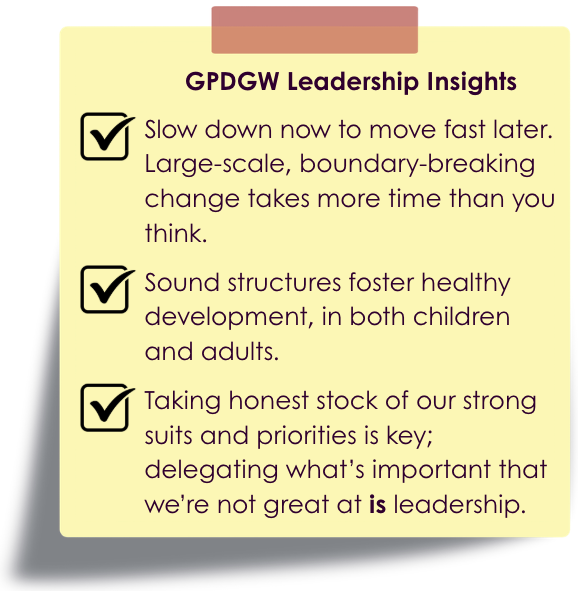
But starting a school with all the things that need to happen on day one, I had to be real with myself around the constraints of making that happen, including the financial constraints.
I’m someone who often operates in a ‘dreaming up the preferred future’ state of mind, so it’s been powerful for me to learn to prioritize. One of the things I'm really homing in on is: we have to do the basic things well. We have to ensure kids get through the doors on time, eat breakfast, and make it to first period. We need to walk through the hallways and hear joy and laughter. We have to do the basic things well, and then we build on that.
How have families been at the center of your planning?
High family engagement is essential to our success. There's a misconception that families don't make time to be heavily involved in their children’s school. That's absolutely not the case. They want to be involved, and it’s up to the school to provide ways for them to be engaged and informed, without creating additional barriers beyond the everyday challenges they're experiencing.
For example, as students swipe to enter the building, their families receive a notification. It’s a small thing, but it’s part of how we maintain high family engagement.
What was a formative experience that shaped how you show up as a leader today?
I grew up in Jamaica. When I immigrated to USA, and entered public school as a 10th grader in Maryland, I felt much less challenged academically than what I experienced in my Jamaican educational journey.
I was a fast-paced learner, so I was the student who always wanted to speed things up. With twenty-something students, the weight of responsibility on my teachers usually fell on providing more help for the child who needed a slower pace. What ended up happening was a subset of us had to just figure it out on our own.
For my development as a young person, I grew up in a household with strong structures, a clear understanding of what consequences look like, and how to repair trust when I’d broken it. All of those things made me a better teenager, and have since made me a better adult.
What was the most surprising part of your journey building ECPHL?
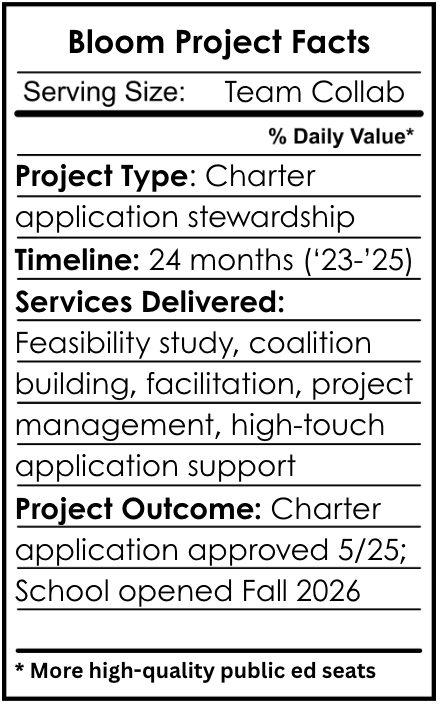
Part of our superpower was that nobody really saw us coming, but we didn't just come out of nowhere. It's been three years, and Bloom was with us from the very beginning. In February 2023 we were planning to submit an application that fall. The Bloom team sat us down and explained to us that it was not going to be possible. We submitted an application almost two years later, because that's how long it took us to do every single component of that application, and do it well, especially the coalition building, building family support, and navigating the political landscape. It was a long process.
I started this journey when I was four months pregnant with twins who are soon going to be three. It has been a lot of keeping our head down and just doing the work. And I think because I am somebody who just gets the work done, I don't need to talk about how I do the work.
I am grateful that my parents raised me with a strong sense of self, because if I did not believe in myself and what we were doing, this process would have broken me a long time ago.
There's never been a room that I felt like I did not deserve to be in. I don't need anyone else’s permission to sit at the table.
I do believe that there are a lot of great things happening in education in our city, especially in public schools. Even within challenging educational spaces, great things can happen in all public schools, including public charter schools.

I'm very honored to do this work, and however long I get to do it, I'll do it to the best of my ability, because that's what kids deserve.
Bonus Question: Who is your DIVA?
I’m going to interpret this question in two ways. First, Oprah is my diva. I always think to myself, ‘You never know if today’s the day I’m going to meet Oprah.’ So when I get dressed every day, I ask myself, ‘Is this the outfit I’d want to be photographed in with Oprah?’ My style is inspired by that future photograph that I know I’ll look at for the rest of my life.
Also, I immediately thought of the song ‘Diva’ by Beyoncé. She is my musical diva.
